

Bearded iris have a flower with three erect petals, called standards, and three drooping petals, called falls. The falls have a hairy center, hence the name bearded iris. Bearded iris do best in full sun and dry, alkaline soils.
Siberian iris have more slender leaves than the bearded iris and have blue, purple and white beardless falls. Culture for Siberian iris is much different than the bearded iris. Siberian iris grow best in moist soil, full sun and naturalize well near stream beds.
Iris are relatively carefree; however, they should be divided every three to four years. Divide the rhizomes, which are underground stems, after the plants have finished flowering, but no later than August. Discard any segments that are mushy or riddled with holes. Separate healthy rhizomes into segments with one fan of leaves and several feeding roots. Cut the leaves back to six inches. When setting the new plant, spread the roots out in the soil and position the top third of the rhizome above the soil surface. Arrange foliage to face outward away from the center of a group.
Brazilian Walking Iris
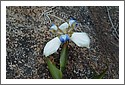
Neomarica gracilis, (Brazilian Walking Iris). Native of regions from Southern Mexico to Brazil. Also known as the twelve apostles, has intricately designed orchard-like white flowers of white with mottled crimson and a blue-violet banding. Glossy green, arching leaves, like an iris which are sometimes more than 24 inches long. Flowers from spring to late summer, prefers partial to full shade. Flowers last only for one day, but multiple blooms will come from the same stem in rapid succession.
Grows in grassy clumps up to 5 feet wide and equally high, does well in pots and particularly suitable to hanging baskets. Flowers appear in one year, two in cooler climates. May survive in the ground in zone 8, best in zone 9 or warmer climates. Require a well drained soil with reasonable moisture.
Propagation is very easy. Finished blooms will develop air roots from which a small plant will grow. Plant the youngster in a 4-inch pot of soil still attached to the mother plant, or snip and repot. Keep well watered and repot when potbound.
IRIS - WEED CONTROL
There are no chemicals currently listed for control of grassy weeds in bearded iris. Chemicals used to control grassy weeds will also damage the iris.
Mulch is not recommended as iris rhizomes will rot.
Glysophate (RoundUp or KleenUp) may be used selectively if not sprayed on the iris foliage.
Weeding by hand is the only other recommended option.
Adapted
from: Colorado State University Cooperative Extension
Sources,
Credits and Copyright